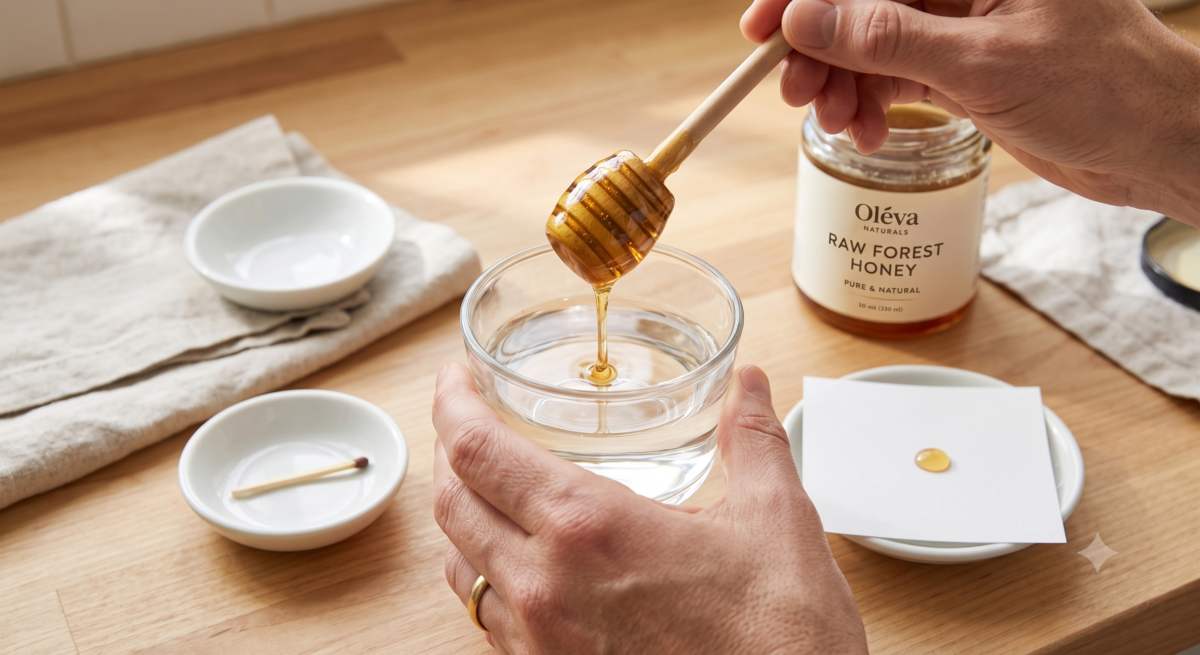
If you want to check pure honey at home, you may come across water, thumb, flame or crystallization tests. No simple home test can reliably confirm honey authenticity. This guide explains how to check pure honey more responsibly, what five common tests actually show, and which buying checks are more useful.
How to Check Pure Honey at Home
There is no single visual or household test that can reliably prove whether honey is pure. Colour, thickness, aroma and crystallization can all vary naturally depending on floral source, moisture, temperature and storage.
If you want to assess honey more intelligently, check the ingredient declaration, manufacturer information, batch and date information, applicable FSSAI details, source transparency and relevant laboratory information when testing claims are made.
Home tests can help you observe how honey behaves, but they should not be treated as definitive purity tests. If your goal is to check pure honey before buying or using it, label information, source transparency and suitable laboratory evidence are more dependable than household tricks.
What Does Pure Honey Mean?
Genuine honey is made by bees from botanical sources and should not contain undeclared added sugar syrups. Its colour, thickness, aroma and crystallization vary naturally with floral source, sugar composition, moisture and storage conditions. Appearance alone cannot prove authenticity.
Five Common Honey Purity Tests—Explained
1. Water Test
Myth: Pure honey settles in water while adulterated honey dissolves immediately. Reality: Dispersion depends on viscosity, temperature and composition. Both authentic and adulterated samples can behave differently. This is not a reliable purity test.
2. Thumb Test
Myth: Pure honey stays in place on your thumb. Reality: Thickness and flow vary by moisture and temperature. A thick drop does not prove authenticity.
3. Flame Test
Myth: A honey-coated wick or match ignites only if honey is pure. Reality: Combustion depends on many factors and says nothing definitive about added syrups. Do not attempt this test: it presents an avoidable fire and burn risk.
4. Crystallization Test
Myth: Crystallization proves purity, while liquid honey is fake. Reality: Genuine honey can crystallize at different rates or remain liquid depending on its natural sugars and temperature. Crystallization does not authenticate honey.
5. Vinegar Test
Myth: Foaming after vinegar is added reveals adulteration. Reality: This is not a validated general-purpose test for added sugar syrups. Neither foam nor its absence establishes purity.

How Honey Is Tested Scientifically
Appropriate laboratory analysis can measure specific parameters including moisture, sugar composition, sucrose, diastase activity and hydroxymethylfurfural (HMF). More specialized testing may be needed to investigate certain sugar-syrup adulterants. Each result covers the methods and sample tested; a single result does not prove every possible claim.
See the FSSAI manuals of food analysis for recognized analytical approaches.
How to Identify Quality Honey Before Buying
When buying honey online or in a store, use this quick checklist:
- Read the complete label: Do not rely only on words like “natural,” “pure” or “premium.”
- Check the source: Understand whether the product is forest honey, organic honey, infused honey or another variety.
- Do not judge by colour: Dark honey is not automatically purer than light honey.
- Do not judge by thickness: Temperature, moisture and floral source affect viscosity.
- Understand crystallization: Crystallization can occur naturally and is not proof of either purity or adulteration.
- Look for traceability: Manufacturer, batch and relevant testing information are more useful than viral home tests.
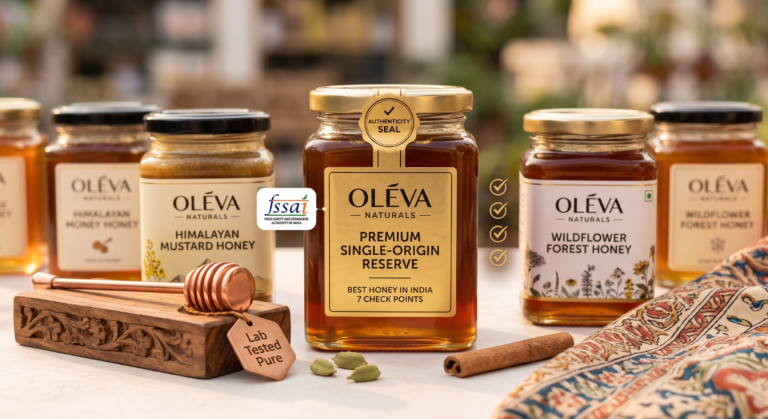
For a fuller buying checklist, read Best Honey in India: Seven Checks Before Buying and our Organic Honey guide.
Storage and Safety
Keep honey tightly sealed, dry and away from direct sunlight; follow its label. Natural crystallization is not in itself spoilage or proof of purity. Never give honey to infants younger than 12 months because of the risk of infant botulism. Honey contributes free sugars, so consume it in moderation.
Explore Oleva Naturals Honey
Discover varieties by their taste and intended culinary use: Organic Honey, Forest Honey and Tulsi Honey. Review each product label for specifics; these are shopping options, not substitutes for authenticity testing.
Frequently Asked Questions
How do I know if honey is pure?
You cannot reliably establish honey purity from appearance or a single home test. Review the label, source, traceability and appropriate laboratory evidence where available.
What is the best way to check pure honey at home?
Home tests can demonstrate differences in viscosity or behaviour, but they cannot reliably prove adulteration. Use them only as observations, not scientific authenticity tests.
Can I check honey purity with water?
No. The water test cannot reliably identify adulteration.
Does crystallization mean honey is fake?
No. Many genuine honeys crystallize naturally; some stay liquid longer.
Is darker or thicker honey purer?
Not necessarily. Botanical source and storage affect colour and viscosity.
What is a better quality check?
Read the label, review sourcing and evaluate appropriate laboratory reports where available.
Final Thoughts
Household tricks can be misleading. For informed purchases, prioritize clear labels, traceability and suitable evidence rather than water, flame or crystallization myths.
6 Comments